Operon is the governed operating layer for agentic AI. A three-plane architecture, six compiled DSLs, deterministic compilation, an immutable Evidence Data Trace (EDT), and governance that runs as the spine of the system rather than a layer on top. Built for teams who've been burned by agent frameworks and want to see the architecture before they see the demo.
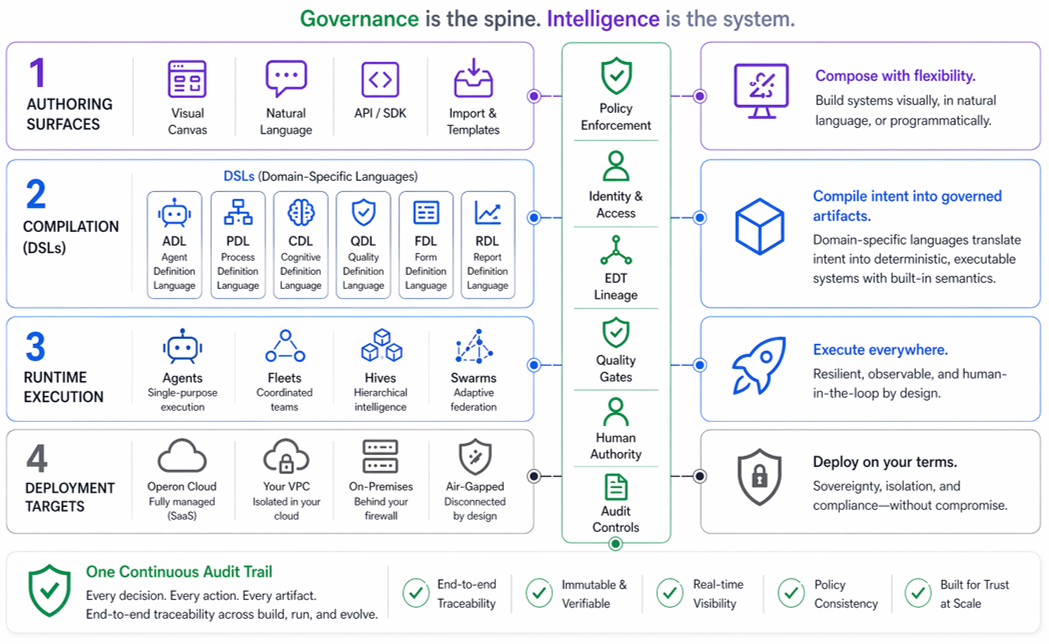
Operon's architecture mirrors the layering enterprise teams recognize from Kubernetes, Istio, and the modern observability stack, not by accident, but because the same separation-of-concerns discipline applies to agent platforms. Operon does one thing differently: governance isn't the fifth layer. It's the spine that runs through all the others.
| Layer | What it does | What lives here |
|---|---|---|
| Authoring | How humans express intent | Natural language, visual canvas, Markdown, direct DSL, APIs, import from existing frameworks |
| Compilation | Deterministic translation from intent to governed artifact | ADL, CDL, QDL, PDL, RDL, FDL: six DSLs, one compiler |
| Runtime | Agents, fleets, and federated fleets running in your environment | Smart routing, orchestration, resilience, escalation, observability |
| Deployment | Where the whole stack runs | Operon Cloud, your VPC, private region, Native App, air-gapped |
No LLM in the compile pipeline. Compilation is deterministic, testable, diff-able, and runs in CI. Authoring is where LLMs help; production artifacts are typed, validated, and reproducible.
Every DSL targets a specific concern. They compose at compile time into a single governed runtime artifact. You can author entirely in the visual canvas and never touch the DSLs, or drop into DSL directly for the last 10% of control. Either way produces the same typed, validated, reproducible artifacts.
Agent behaviors, event handlers, state machines.
Workflows, SLAs, approval gates, orchestration.
Data capture forms and structured input.
Report templates and data aggregation.
Semantic domain modeling and decision logic.
Compliance rules, output gates, staff accountability.
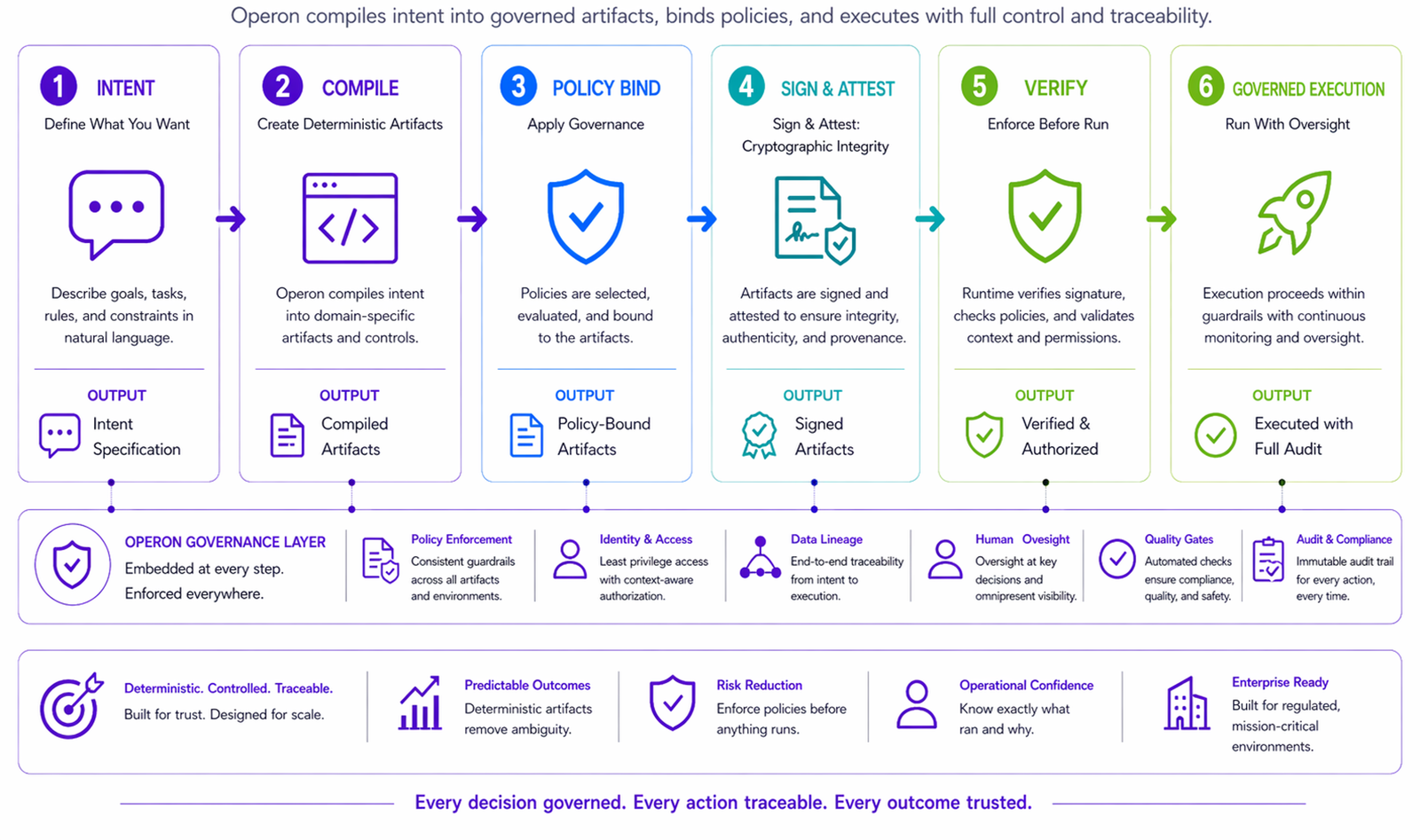
A user describes intent through any authoring surface. The compiler transforms it into typed, deterministic artifacts. Policies, in OPA/Rego, are evaluated and bound to each artifact as enforceable constraints that travel with the code into production. Each artifact is then cryptographically signed at build time so its provenance and integrity are independently verifiable. At runtime, before any agent acts, the runtime verifies the signature, re-checks policy against current context, and validates permissions. Only then does governed execution begin, with every decision logged to the immutable EDT, every constraint violation escalated, every agent operating under a declared authority ceiling. Governance isn't a policy layer bolted on top. It's the architecture.
Each stage produces a typed output that becomes the input to the next. The chain is deterministic, reproducible, and diff-able in CI.
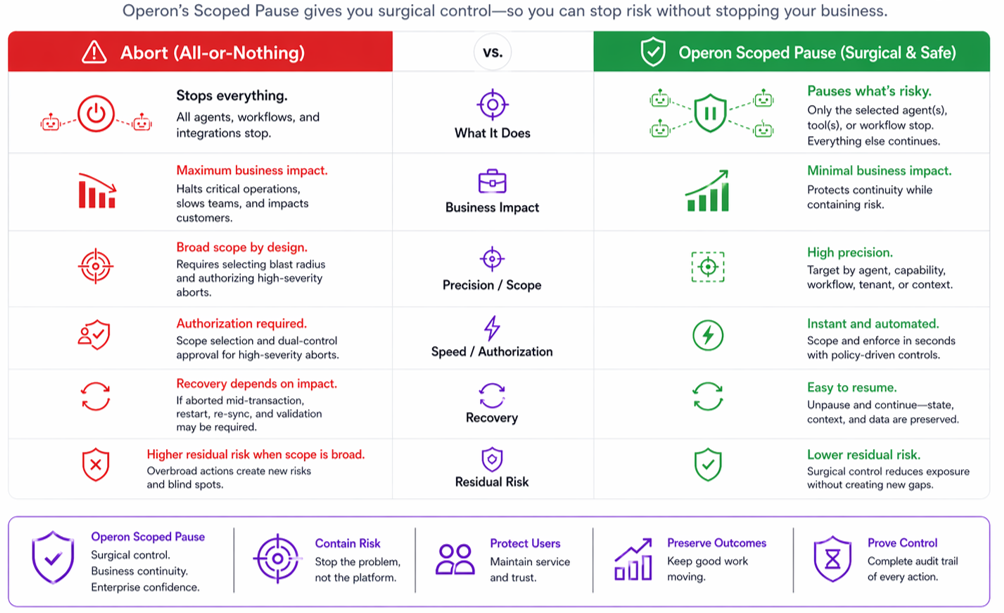
The AI safety conversation keeps reaching for the kill switch. OWASP recommends one, prominent CTOs call for one, and naive implementations will ship them. A literal kill switch in a regulated workflow is an anti-feature: an agent killed mid-write leaves a record in an ambiguous state; a financial agent killed mid-transaction leaves orphaned compensating actions and broken reconciliation. Regulated operations require the opposite posture for automated decision systems. Fail-safe means predictable transactional boundaries, not abrupt termination.
At configurable scope: tenant, business unit, platform-wide, specific agent, specific fleet, specific skill.
To their next transactional boundary with full EDT logging. No torn writes.
All workflow steps after the pause are placed behind QDL human-approval gates.
Required at business-unit scope or higher. The mechanism your compliance officer can point to.
Forensic capture is engaged automatically. Every paused state is reconstructable later.
This is architecturally correct, not a marketing correction.
Operon does not replace your identity provider, your data warehouse, your model providers, your observability stack, or your compliance tooling. It orchestrates across them and gives leadership one build-and-run model above them.
SSO, SAML, OAuth, OIDC; ABAC/RBAC integrations with Okta, Auth0, Azure AD, Google Workspace.
OpenAI, Anthropic, Google, Meta, Mistral, Cohere, Snowflake Cortex, Databricks Mosaic, Salesforce Atlas, custom models.
Snowflake, Databricks, BigQuery, via Semantic Data Typing (SDT) Runtime. Data stays in warehouse.
OpenTelemetry-native EDT export; compatible with Datadog, Dynatrace, Grafana, Splunk.
Evidence-pack generation for SOX, HIPAA, GDPR, EU AI Act; exportable to any governance-as-code pipeline.
GitHub, GitLab, Jenkins, ArgoCD; skill libraries in SKILL.md format; container-based deployment into your own cloud.
Every governance platform claims the same things: unified oversight, policy enforcement, audit trails, sovereignty. The differences show up when you ask specific architectural questions. These are the ones that matter most. Ask them of every vendor you evaluate, including us. Our answers are below each question.
What happens to in-flight work when your kill switch fires?
Why it matters. In regulated workflows, terminating an agent mid-transaction creates worse outcomes than letting the undesired behavior finish. An agent killed mid-write leaves a record in an ambiguous state, an operational hazard and an audit-integrity violation at the same time. A financial agent killed mid-transaction leaves compensating actions orphaned and regulatory reporting broken. Regulated operations require predictable transactional boundaries, not abrupt termination. A literal kill switch in an "AI governance platform" is an anti-feature in any environment where transactional integrity matters.
Scoped emergency pause. Halt dispatch of new agent actions at configurable scope: tenant, business unit, platform-wide, specific agent, specific fleet, specific skill. Let in-flight actions complete to their next transactional boundary with full EDT logging. Place all subsequent workflow steps behind explicit human approval. Dual-control authorization required to resume above a severity threshold. Stop the problem, not the platform.
Can you show me deployment independence, vendor independence, and format independence, separately?
Why it matters. "Own your control plane" means three architectural properties most buyers collapse into one. All three matter. A platform that delivers only deployment independence is deployable-but-locked-in. Only vendor independence is neutral-but-hosted-elsewhere. Only format independence is portable-but-still-in-the-vendor's-cloud. Vendors that can't separate the three in a conversation are usually hiding behind the strongest one.
Deployment: architected to run as a Snowflake Native App, a Databricks App, in your VPC, or fully air-gapped. Row data never leaves your perimeter; only governance metadata does, and only in the SaaS posture. Vendor: no competitive exposure to any model provider or platform we govern, we compete with none of the platforms in our target estate. Format: EDT is open-schema, OpenTelemetry-compatible, queryable SQL, regulator-friendly evidence packs. You own your history even if you leave us.
Does your governance run at the data layer or around the agent's execution, and can it govern agents running outside the platform it lives in?
Why it matters. Two different things get called "AI governance." Data-layer governance, catalogs, lineage, classification, masking, guardrails on what reaches a model, is necessary, but it does not govern the agent's behavior: the decisions, the tool calls, the multi-step execution. And governance that lives inside one platform tends to govern best inside that platform. The enterprise question is whether the same envelope reaches an agent running in another cloud, another warehouse, a SaaS app, or on-premises, or whether each estate needs its own.
Operon governs the execution layer: author-able quality gates (QDL), gate-scoped pause and auto-pause, benchmarking, simulation, and promotion gates around the reasoning itself. It runs in your trust boundary rather than a platform's, so the same envelope applies whether the agent runs in your VPC, a warehouse, a SaaS system, or air-gapped. It composes with data-layer governance rather than replacing it: a warehouse's catalog and guardrails secure what the agent reads; Operon governs what the agent does.
If a model provider's API key were compromised, would your telemetry of their traffic also be compromised?
Why it matters. Blast-radius analysis. A governance layer that shares infrastructure with the thing it's governing shares the vulnerabilities. Microsoft governing Copilot, Salesforce governing Agentforce, OpenAI governing its own models, all sit inside the same trust boundary as the risk they're supposed to monitor. Independent governance means the governance layer runs somewhere the model and platform layers cannot reach. Different infrastructure, different blast radius, different compromise surface.
The governance plane runs in your perimeter: your Snowflake account, your Databricks workspace, your VPC, or your air-gapped facility. The model provider cannot reach it. Their compromise does not compromise our telemetry of them. This is what sovereignty actually requires architecturally.
What code do I change to switch reasoning providers for production agents?
Why it matters. Model-provider market share shifts month to month. The reasoning model that wins Q2 isn't necessarily the one that wins Q4. Swapping the model itself is a dropdown on most of these platforms; that is not where the lock-in lives. The lock-in is that the agent definition, the memory, and the audit trail sit in the provider's cloud, so when you want to leave, you are migrating schemas and reconstructing history, not changing a setting. That is the "platform creep" trap: managed agents where the provider owns the orchestration, the memory, and the audit, and portability is theoretical.
One registry entry per agent. Agent definitions, conversational memory, tool invocation history, and audit trails live in your environment, not the provider's. Switching from Claude to GPT to Gemini to a custom model is a configuration change. The agent definition stays. The memory stays. The audit trail stays. The governance envelope stays. Only the reasoning call destination changes.
To govern one more agent running outside your primary platform, what does it cost, net-new vendor consumption, or nothing?
Why it matters. Bundled governance is "free" only inside the platform you already pay for. The moment your governance scope crosses into another estate, platform-metered models charge you to extend coverage, or simply cannot reach it. A control plane priced to the platform grows its bill with every agent and every seat; a control plane that runs on infrastructure you already own does not.
Operon's governance kernel runs on infrastructure you already operate, and it is licensed by agents in production rather than by seat or by platform consumption. Governing an additional agent, in any estate, adds no net-new vendor consumption and no per-seat platform tax; you expand coverage without expanding anyone's bill but your own compute. The ROI calculator quantifies it against your current platform mix.
Full treatment of each question, the architectural reasoning, the regulatory context, and the worked examples, is in our essay Beyond the Governance Mirage. We publish the questions because we want to be chosen on architecture, not by default.
Specialized capability moves down a Fleet, from Lead to Worker, pinned to a version and gated by a human. It does not spread on its own — because capability that spreads on its own is exactly what a governance team is right to be afraid of.
When a Lead spawns a Worker, the operator picks a specialization profile, decides whether the Worker inherits the Lead's adapter, and sets how long the Worker lives — permanent, or a fixed number of days. If the Lead has no completed adapter, inheritance isn't offered at all; the option is disabled rather than quietly doing nothing. If it does have one, the interface names the version the Worker will start from, so "what is this agent actually running" has an answer that is a string someone can read rather than an inference someone has to make.
The request does not execute on the operator's say-so. A Worker spawn is a Tier 6 event: it waits on human approval, and the Lead that raised it carries a pending badge on the canvas until somebody decides. Only then does the Worker exist.
Capability is bounded on the way in and on the way out. Every skill dropped onto a Worker is validated against that Worker's CDL capability ceiling at the moment it lands; one that exceeds the ceiling renders in an error state and cannot execute, though it can always be removed. Skills inherited through the Hive run the other way: a tenant cannot quietly strip them.
The Worker starts from a named adapter version. Moving it to a newer one is a decision with a record behind it, not background drift that shows up later as a behaviour change nobody ordered.
Spawns wait on a human at Tier 6. There is no path in which a Fleet quietly grows a new specialized agent while everyone is looking somewhere else.
A spawned Worker can carry a lifetime and retire itself. Specialized capability doesn't have to outlive the reason it was created, which is how estates stop accumulating agents nobody remembers commissioning.
The Hive itself carries a single adapter version, shown on the operations console beside tier distribution, node count and EDT event rate. It is the knowledge layer agents query — not a second place where capability is composed.
Every authoring surface produces the same typed artifacts: agent definitions, a workflow graph, form and report definitions, and the policy bindings that govern them. They are readable, diffable, and reviewable in the same pull request as the rest of your code — which is what makes a governed agent something your team can argue about before it ships rather than after.
Skills are plain Markdown with typed front-matter. Add a skill by writing one.
The compiler is pluggable. Write a custom DSL for a domain Operon doesn't ship with.
Bring your own OPA/Rego library and enforce the policies you already maintain.
OpenAI, Anthropic, Google, Meta, Mistral, Cohere, your own. Adding a provider is a config file.
Each importer — LangGraph, n8n, CrewAI, AutoGen — is its own module. Write a new one for a framework we don't cover.
OpenTelemetry-native. Datadog, Splunk, Grafana, your warehouse. Drop in an exporter.
Architecture review sessions are run by our principal architects, not sales engineers. The deliverable: a tailored architectural sketch of how Operon would compose with your platform mix, plus answers to your version of the evaluation questions.
Tell us your platform mix and the evaluation questions you care about. Sessions are run by principal architects, not sales engineers.
45 minutes. No demo unless you ask. We'll bring the architectural sketch and the rubric. You bring the platform mix and the constraints.