Not governance claims. Governance artifacts. Open Policy Agent enforcement, structured decision traces, runtime sandboxing, and semantic data protection, verifiable, auditable, and built into every decision.
Connect the execution path. Make the boundary explicit.
Discovery identifies agents. Enforcement applies to actions that pass through Operon's runtime or a configured interception point.
Imported agents. Agents admitted into the Operon runtime use its policy checks and decision traces. Review the imported tools and bound policies before promotion to production.
Existing executors. The governance wrapper intercepts configured outbound model calls. Tool calls and other execution paths need their own governed routing; wrapping a model call does not establish control over every action the agent can take.
Your wider governance program. Operon's execution records can support control reviews and audit evidence alongside your existing GRC tools. Agree evidence mappings and transfer requirements during the architecture review; a packaged connector is not implied.
Three illustrative artifacts show the intended enforcement path: a policy, an approved action trace, and a denied action trace. Use them to frame an architecture review against your own workflow.
Constraint enforcement with OPA.
Policies are declared in OPA/Rego. The runtime evaluates each agent action against the bound policy before dispatch. The same policy runs at compile time (binding to artifacts) and at runtime (verifying current context). One source of truth.
# policy.rego: Clinical agent: PHI write controlspackage operon.clinical.phi
default allow = false# Allow PHI writes only when:
# - Agent is on the approved list AND
# - Action is escalated to a clinician on the care team AND
# - The classification of the data matches the agent's clearance
allow {
input.agent.id == data.approved_clinical_agents[_]
input.action.kind == "phi_write"
input.escalation.reviewer.role == "clinician"
input.escalation.reviewer.member_of == input.patient.care_team
input.data.classification <= input.agent.clearance
}
# Always escalate when the agent is uncertain
escalate {
input.confidence < 0.85
}
What an EDT trace actually looks like.
The Evidence Data Trace is the immutable record of every governed action: the agent, the input, the policies fired, the model version, the human reviewer if any. Open-schema, queryable in SQL, exportable to OpenTelemetry.
An agent attempts to write outside its clearance. Policy denies. The action never reaches the model. The denial is logged. The reviewer is notified. The agent's authority ceiling is reduced for review. No surprise outputs reach production. No partial state in the system of record.
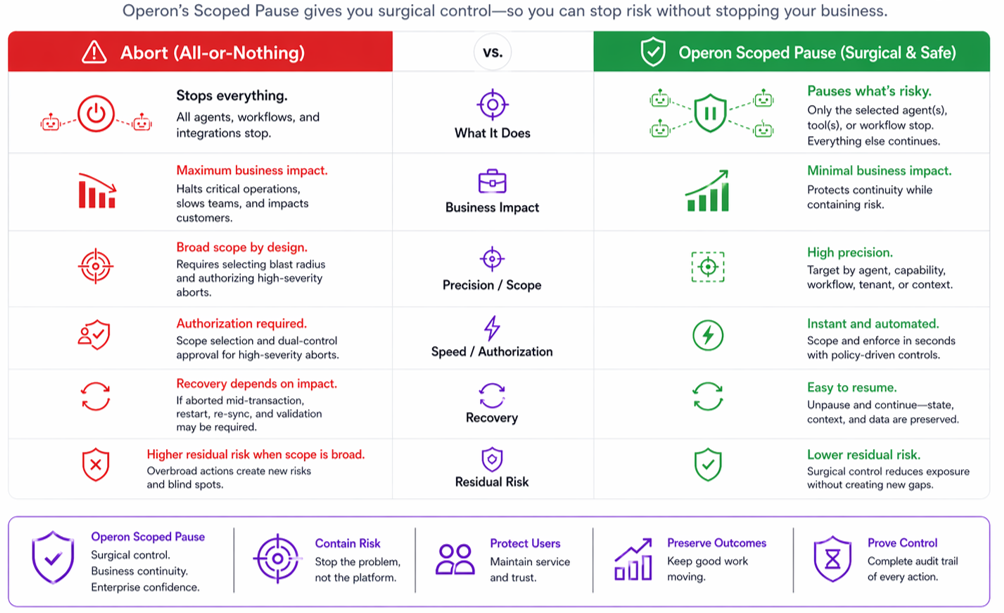
A literal kill switch in a regulated workflow is an anti-feature: it leaves records mid-write and financial transactions with orphaned compensating actions. Regulated operations require predictable transactional boundaries, not abrupt termination.
Operon's scoped pause. Halts new dispatch at configurable scope. Lets in-flight actions complete to their next transactional boundary. Places subsequent steps behind explicit human approval. Requires dual-control quorum to resume above a severity threshold. Logs every paused state to EDT for forensic reconstruction.
Risk and ethics guardrails
The pre-deployment checklist.
Before an agent reaches production, three questions have to be answered with evidence, not intent: is it safe to run, is it fair to the people it affects, and can you prove what it did. These are the gates Operon is built to enforce and record.
Pillar 01
Safety and control
Risk tier assigned and documented
Fails-safe scoped pause and rollback tested
Action permissions set to least privilege
Blast radius bounded and rehearsed
Pillar 02
Fairness and ethics
Bias and disparate-impact tested
Human rights and dignity reviewed
Disclosure to the people it affects
Contestability and appeal path defined
Pillar 03
Trust and assurance
Evaluation baseline and golden datasets
Data lineage and privacy verified
Full audit logging enabled to the EDT
Incident response plan in place
Operon replaces the raw kill switch with a fails-safe scoped pause, so halting a problem never leaves a record half-written or a transaction with orphaned compensating actions. Every item on this list produces an artifact in the Evidence Data Trace, not a line in a slide.
Governance operating model
Autonomy with accountability.
Agents can act on their own. Accountability never should. As autonomy rises, the question is not whether a human is in every loop, it is whether a named human owns every boundary the agent operates inside.
The agent executes the action. A named human owns every decision boundary it runs inside.
Influencing rolesWho enables the agent
Provides the modelSupplies the reasoning capability
Runs the platformSets the runtime constraints
Integrates itConnects workflows and tools
Operating ownershipWho runs it day to day
MonitorWatches behavior in production
ApproveGates the high-stakes actions
InterveneHandles drift and exceptions
Primary accountabilityWho owns the authority
Determines authority scopeSets how far the agent may act
Approves the use caseOwns why it runs at all
Defines permissionOwns what it may touch
Incident ownershipWho owns it when it goes wrong
ReportOwns the impact assessment
SuspendHalts execution under authority
InvestigateRuns the root-cause from the trace
Operon binds each of these boundaries to policy, records who holds them in the audit trail, and routes every escalation to the human who owns it.
Cross-boundary federation
Sovereign intelligence sharing. Without merging trust boundaries.
Fleets in different legal entities, regions, or classification levels can exchange signed results through the Control Plane without exposing prompts, weights, or private memory. Federation flows through audit, not around it.
Compliance posture
One audit trail. Every evidence pack.
Because EDT is one open-schema record, evidence packs for SOX, HIPAA, GDPR, EU AI Act, and ISO 27001 generate from the same source, no hand-assembly across five systems.
HIPAA
PHI access, agent identity, reviewer attribution. Evidence packs map to 45 CFR Part 164.
SOX
Material control evidence with deterministic compile artifacts and signed runtime decisions.
GDPR Art. 22
Decision traces include the human-in-the-loop attribution required for automated-decision-making controls.
EU AI Act
Article-by-article alignment for high-risk AI systems; conformity-assessment-ready evidence.
Your existing ISMS
Private-cloud and air-gapped deployments inherit your existing ISMS controls. Certification status for Operon Cloud is available on request.
Show your auditor, regulator, or board the trace.
Schedule a 45-minute architecture review. We'll map Operon's governance artifacts to your current evidence model, and show you the gaps either way.