The platform

The agentic operating system.
Three planes, one governed runtime.

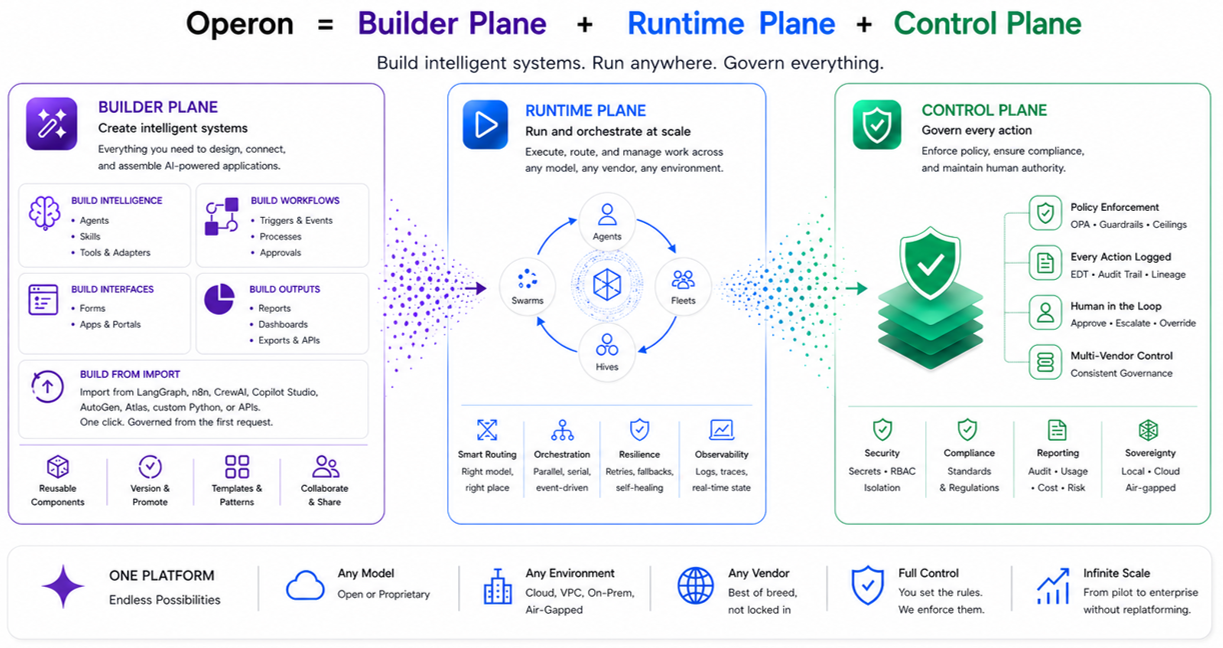
Build, import, and run enterprise agents in a governed runtime. Operon combines authoring, orchestration, model routing, policy enforcement, and decision traces across supported providers and deployment environments.

The control plane in motion

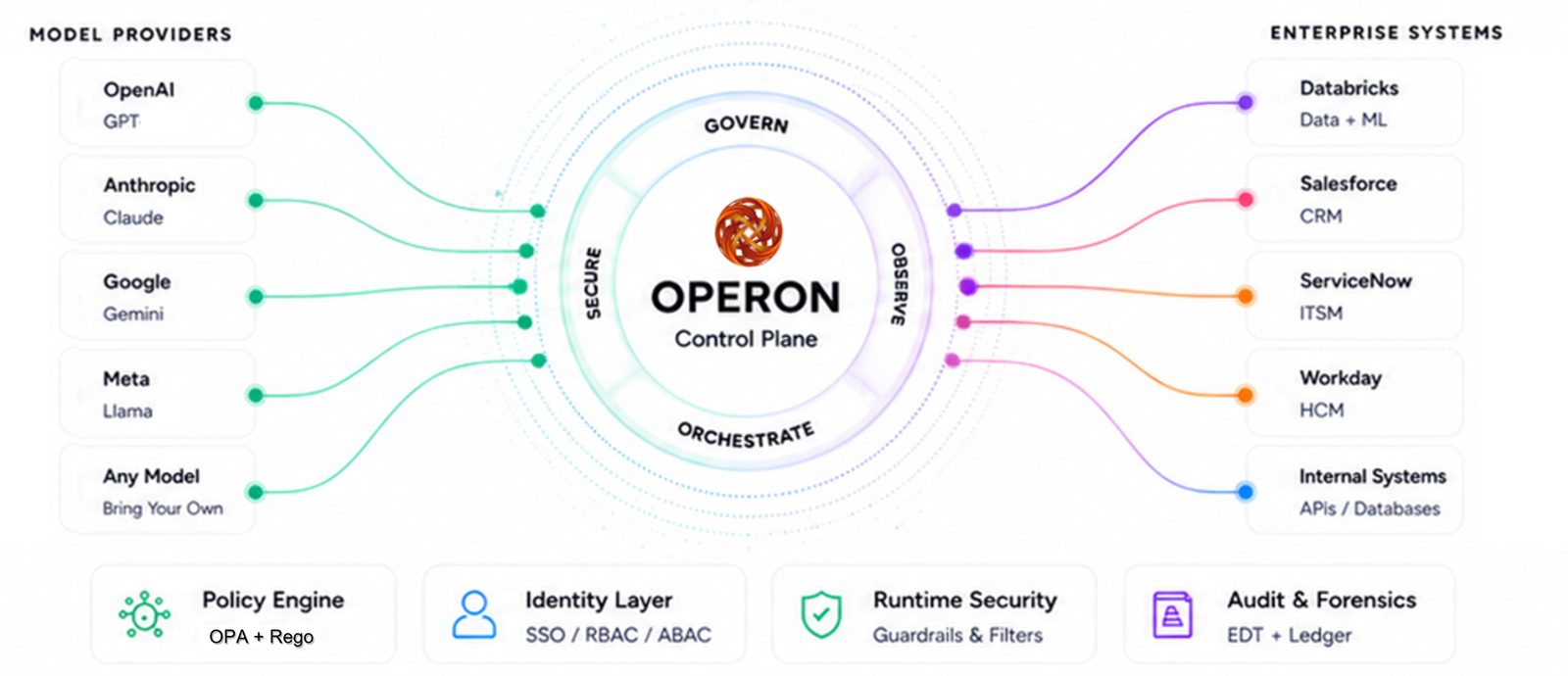
Connect your stack through governed execution.

Operon connects supported model providers and enterprise systems through its runtime. Actions dispatched through that runtime carry policy checks, identity, decision lineage, and required human approvals. Coverage depends on which execution paths you connect.

Operon control plane: model providers on one side, enterprise systems on the other, with govern, secure, observe and orchestrate around the hub
Two execution paths

Import into the runtime. Or connect an existing executor.

Imported agents compile into Operon's governed runtime. Existing executors can use a governance wrapper for configured outbound model calls. In both cases, the connected execution path determines what Operon can enforce.

Discovery alone does not put an agent under policy. Review the model calls, tools, credentials, and routes that must cross an enforcement point, including any paths that remain outside it.

Inspect governance coverage and decision traces →

The three planes

Build it. Run it. Govern it. Without trading any of the three.

Builder, Runtime, and Control planes
Builder Plane

Author in any surface. Compile to one runtime.

Natural language, visual canvas, Markdown, direct DSL, or one-click import from LangGraph, n8n, CrewAI, AutoGen, Copilot Studio, or custom Python. Every authoring path produces typed, validated artifacts the runtime can execute.

  • NL2Operon Describe
  • Visual canvas Drag
  • SKILL.md Write
  • Direct DSL Compose
Runtime Plane

One agent or ten thousand. Same envelope.

Smart routing across providers, fallback chains, cost guardrails, environment profiles. Scale from a single agent to federated fleets across regions and legal entities, under the same governance.

  • Model routing SLO-aware
  • Fallback chains Signed
  • Cost guardrails Per team
  • Environment profiles 4 tiers
Control Plane

Policy is runtime. Audit is exhaust.

Actions dispatched through the governed runtime evaluate against OPA/Rego policy before execution. Decisions are recorded in the Evidence Data Trace, and required approvals route to a human with full context.

  • Pre-exec checks OPA/Rego
  • EDT log Tamper-evident
  • Human-in-loop QDL gates
  • Audit retention Indefinite
The stack, end to end

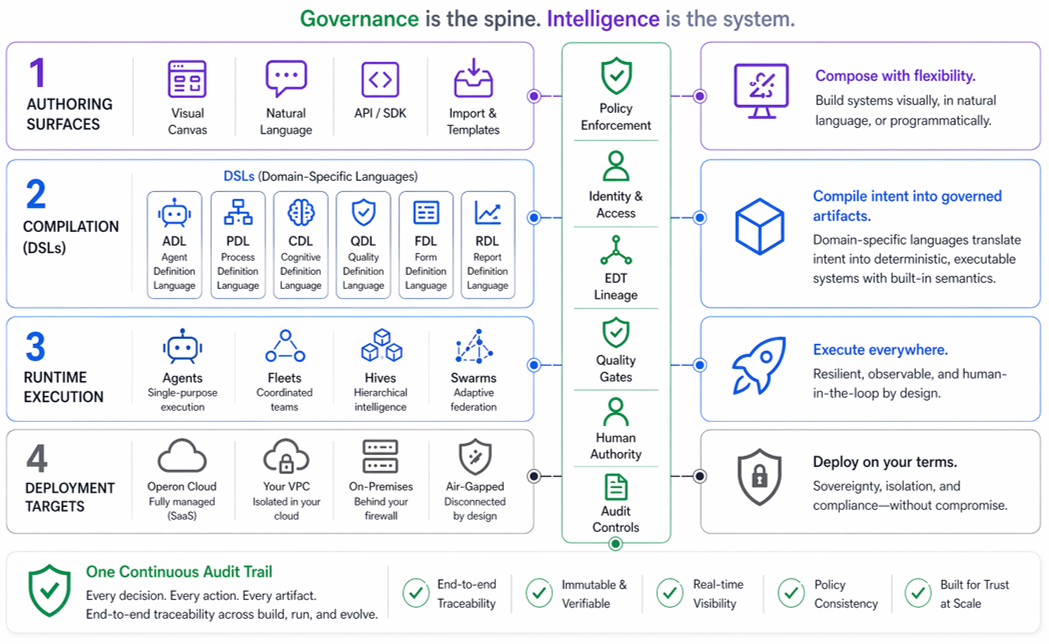
Governance is the spine. Intelligence is the system.

Four layers (authoring, compilation, runtime, deployment) share one continuous audit trail. The full architectural treatment lives on the CTO page.

Authoring → Compilation → Runtime → Deployment with governance spine
The agent model

Fleets are sovereign peers. They combine sideways, not upward.

A Fleet is a governed team: a Lead orchestrating Workers, watched by a Guard and a Scout. A Hive is the deployment it runs inside. There is no ladder of progressively larger boxes — Fleets federate as equals, under one governance layer, from one agent to ten thousand.

Inside a Fleet

HIVE GUARD SCOUT LEAD WORKER WORKER WORKER KNOWLEDGE GRAPH · ROUTING · NORMS · PATTERNS
The Lead dispatches. Workers execute. The Guard intervenes and can spawn short-lived clones; the Scout observes read-only. All of them query the Hive graph — it answers, it never orchestrates.

Between Fleets

SOVEREIGN PEERS FLEET FLEET FLEET FEDERATION One composite fleet. Shared subgraphs, no copying. Peers, not tiers.
Two or more Fleets federate into a composite fleet under a Fleet Union Agreement, joining their knowledge subgraphs through a namespace-scoped overlay. Nothing is copied, and nothing is centralized.
THE UNIT

Agent

One identity

A single governed agent with its own role, policies, and audit trail. Authored, compiled, signed, audited end to end.

THE TEAM

Fleet

Lead and workers

A Lead orchestrating Workers, with a Guard that intervenes and a Scout that observes. This is the production unit, and it lives in exactly one Hive.

THE DEPLOYMENT

Hive

Runtime and knowledge

One dispatch bus and one knowledge graph the agents query for routing rules, platform norms, and accumulated patterns. A Fleet has a Hive; a Hive is not a bag of Fleets.

THE CYCLE

Colony

How work runs

Mission, Architecture, Execution, Observation, Intervention, Synthesis, Retrospective. Seven phases, each owned by a named role rather than left to emerge.

THE COMBINATION

Federation & Mesh

Sideways, not upward

Fleets federate into composite fleets under a union agreement. An Agent Mesh is a transient group of peers coordinating during execution, led by a Lead or Guard.

More intelligence. More agents. One governance layer.

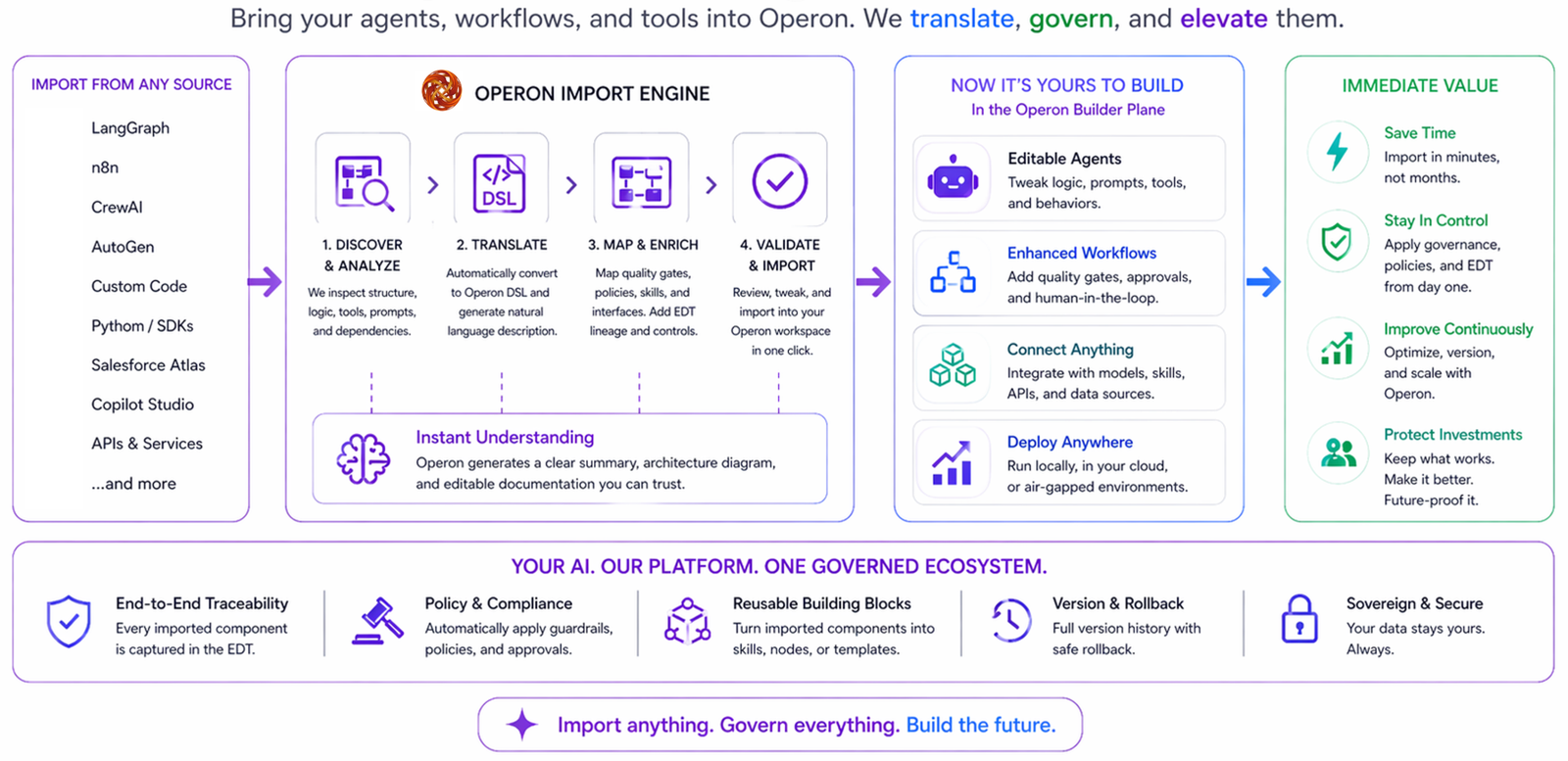
Import what you have

Don't start over. Upgrade.

LangGraph, n8n, CrewAI, AutoGen, Copilot Studio, custom Python: every existing graph compiles into the same governed intermediate representation. Your prior work isn't replaced; it's adopted.

Operon import engine: discover, translate, map, validate

Importing someone else's agent is the riskiest thing you'll do this quarter.

Every import is a stranger's code entering your environment, and Operon treats it that way. The graph is analysed statically before anything runs. The archive is validated before it is unpacked. Code nodes are scanned against a blocked-pattern list covering network access, filesystem and process access, and dynamic evaluation — eval, new Function, child_process, subprocess, __import__ — and every match carries a severity rather than a bare flag, so a hardcoded os.environ read and an outbound socket don't land in the same bucket.

Hardcoded credentials are found and named: bearer tokens, AWS access keys, GitHub and Slack tokens, private key blocks. Tool names are checked against reserved namespaces, so an imported agent cannot shadow a platform capability by claiming its name. Every discovered tool is then evaluated against your own OPA policy, and the gate passes only when there are zero blocking violations. Where the incoming execution context leaves something unspecified, restrictive defaults apply — the safe answer is the default answer.

What does need to execute, executes inside a pooled, lifecycle-managed container with a hook at the Python import boundary. And the scrutiny doesn't stop once the agent is through the gate: imported agents are given a behavioural baseline, and deviations from it surface afterward, which is when the interesting failures actually happen.

01

Analysed statically. Never executed to find out what it does.

02

Archive validated before unpacking. Secrets found and named.

03

Your OPA policy decides. Zero blocking violations, or no import.

04

Baselined after admission, so drift is visible later.
Who builds these

The person who knows the process builds the agent.

Three doors in, and only one of them expects you to write code. Describe what you want in a sentence, write it as reviewable Markdown, or draw it on the canvas. All three compile to the same typed artifacts and land under the same policy, so the authoring surface is a preference rather than a permission level.

Describe it · NL2Operon

Say it in a sentence.

Natural-language authoring. Operon generates the agent definition, the workflow graph, and the policy bindings. Output is editable in the canvas, the Markdown spec, or the DSL, your call.

  • Prompt-to-agent in under a minute
  • Auto-generated SKILL.md, ADL, PDL
  • Round-trip editing across all surfaces
Design it · Visual canvas

Drag, drop, connect.

Graph-based composition for workflow logic, fleet membership, and policy gates. Live validation against the type system. Every edit is a deterministic compile.

  • Live type-checking
  • Inline policy preview
  • Imports render natively (no JSON soup)
Write it · Markdown / SKILL.md

Write what your agents do.

Skills are checked-in Markdown. Versioned, reviewable, signable. SKILL.md is the unit of agent capability: discoverable, composable, and portable across every agent in the estate.

  • Git-native workflow
  • Composable across agents
  • Shared skill library
Forms & Sites

Ship the user-facing surface too.

Forms Builder and Site Builder generate human-facing interfaces (intake, review, approval, dashboards) that share the same policy layer as the agents behind them. One operating model, end to end.

  • Forms compile to FDL
  • Sites compile to RDL + ADL
  • Single sign-on across surfaces
Deployment postures

SaaS, VPC, Native App, or air-gapped. Same governance envelope.

OPERON CLOUD Managed by Operon OPERON BOUNDARY OPERON Your warehouse Metadata egress Row data stays in your warehouse YOUR VPC Your cloud account YOUR BOUNDARY OPERON Row data Controlled egress Only governance metadata leaves NATIVE APP Snowflake / Databricks YOUR DATA PLATFORM OPERON Row data No row-data movement Networked, not offline AIR-GAPPED Fully offline SEALED PERIMETER OPERON Row data No egress Nothing leaves at all
A Native App is not an air-gapped install. As a Snowflake or Databricks Native App, Operon executes inside your data platform account, so row data never moves — but the environment is still networked. Air-gapped means nothing leaves at all.

Ready to see it in your environment?

Request access. We'll match you to the right edition and the right next conversation.

Book an architecture review →

Tell us your organization and the AI platforms you already run, and we'll match you to the right edition. We reply within one business day.