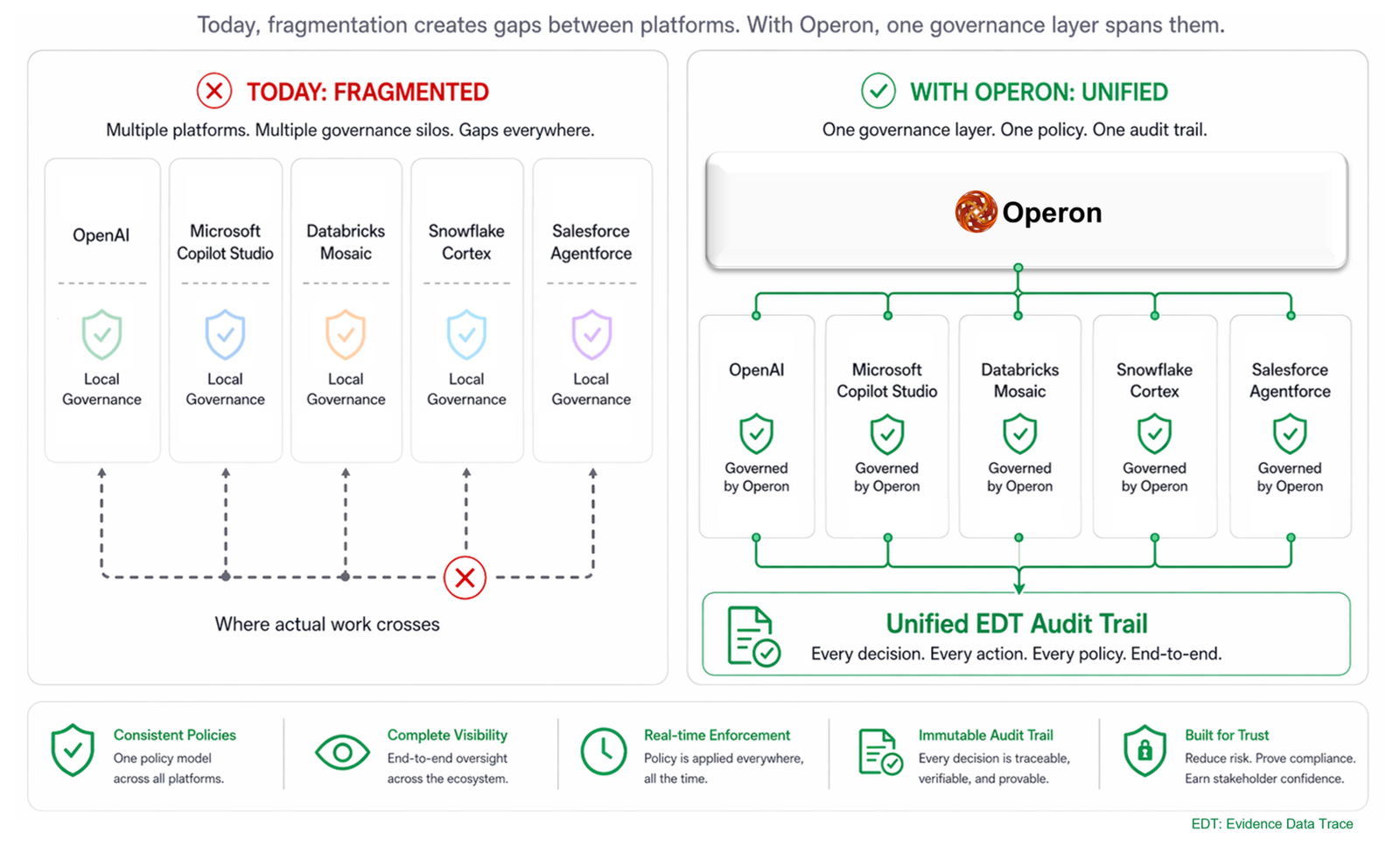
Your AI estate spans multiple platforms, teams, and data boundaries. Operon brings connected agents under execution policies and approval gates, with decision records your operations, security, and compliance teams can review together.
Inside each of your primary AI platforms, governance is a solved problem. Microsoft governs Copilot. Salesforce governs Agentforce. Snowflake governs Cortex. Each vendor has built real controls for the agents running inside their own platform, and those controls work as advertised, for that platform, in isolation.
The problem is not inside any one of them. The problem is the space between them.
Your agents cross platforms constantly. A single workflow pulls data from Snowflake, reasons over it with Claude, generates a draft in Copilot, routes it through a Salesforce approval, and writes back to Epic. No single vendor sees the full path. No single vendor's governance applies to the full path. When something goes wrong (a PHI leak, a hallucinated commitment, a policy violation) the forensic reconstruction has to assemble evidence from five separate systems in five separate formats, each one able to explain only what happened inside its own walls.
That cross-platform gap is where the governance problem lives, and it is not a problem any single platform vendor can solve. Any vendor's own governance runs inside that vendor's infrastructure, sees only that vendor's agents, and cannot, by architectural construction, govern across the boundary to a competitor's platform. Closing the gap requires a layer that is structurally independent of every vendor it governs.
Peer organizations at the scale of the 90,000-employee hospital system or the money-center bank are reaching this conclusion independently and starting to build this layer in-house. They are correctly diagnosing the shape of the requirement. The question is whether to build it or buy it, and whether to reach that decision before a production incident makes it urgent.
Your teams are shipping agents now, with or without your governance. Operon lets them ship faster than they do today on LangChain or custom Python glue, while every agent is born into the governance envelope automatically. You stop trading speed for control.
Every decision produces an immutable audit trace, Operon's Evidence Data Trace (EDT), capturing input data, model version, policies fired, confidence score, and human reviewer if any. When an auditor, regulator, or board member asks "what did our AI do to this case in March?", one query answers it. SOX, HIPAA, GDPR, and EU AI Act evidence packs generate from the same underlying trace.
Model-provider market share is shifting on a month-to-month basis. Committing a multi-year AI strategy to any single reasoning provider is making a bet no current data supports. Operon preserves optionality by construction: you bet on the governance layer, and swap reasoning providers (OpenAI, Anthropic, Google, Meta, your own) as the market decides.
OpenAI, Anthropic, Google, Microsoft, Salesforce, Snowflake, Databricks, Epic, ServiceNow, your custom work. One policy definition. One audit trail. One human-in-the-loop interface. One place to point the board when they ask.
The new shadow IT isn't a SaaS app someone signed up for. It's an autonomous agent someone built. The agent did not arrive in your environment through a procurement review. It arrived through a Git clone, an API key, and a developer who needed to ship something on Friday. By the time the security team sees it, it's the third one this month and the fifth team asking whether it's allowed. Endpoint detection vendors already report that a typical enterprise runs a sprawl of distinct AI applications and agents across employee devices, most of them outside any governance envelope, most of them authenticated with personal or shared credentials, most of them invisible to the compliance team that will be held accountable when one of them leaks.
Shadow agent incidents, when they surface, cost measurably more than standard security incidents: the forensic reconstruction is harder, the affected data is harder to scope, and the regulatory exposure compounds with every agent that turns out to have touched sensitive records. The breach is not the agent. The breach is the absence of a governance layer the agent could have been born into.
Discovery, finding the AI you didn't know you had, is the first problem, and Operon does it first-party. Point it at a GitHub organization or a filesystem path and it sweeps for agent definitions across more than eleven platforms, statically. It never executes what it finds. It never writes to your repositories: no commits, no branches, no key rotation. And it never retains source, because what comes back is paths, hashes, structural facts and line spans, not file contents, secret values, or prompt text. Schema detection runs in under a hundred milliseconds per file with no model call, which is what makes sweeping an entire organization affordable rather than theoretical.
Every finding arrives as a candidate. Nothing is auto-onboarded, and that is a deliberate refusal rather than a missing feature: a scanner that adopts what it finds is a scanner that anyone who can commit a file into a watched repository can use to inject an agent into a governed platform.
Confidence comes from four deterministic signals: whether the definition sits in first-party code or something vendored, whether it's complete or a fragment, whether anything actually references it, and how recently it changed. No model call. An operator can interrogate every score, which is the only reason they'll keep trusting it.
When a repository is large enough that the host truncates its file listing, the sweep says so. A scan that silently skipped forty per cent and reports "three agents found" is worse than no scan at all, because it reads as an all-clear.
Discovered credentials are inventoried by metadata alone — the record has no field a secret value could live in — then attributed to provider accounts, correlated across repositories by fingerprint, and flagged when they've gone dormant.
Scans are scheduled and diffed run over run. One sweep is an inventory. A repeating sweep is a conformance check, and the delta — what appeared, what moved, what quietly disappeared — is what an operator actually reads.
Your existing EDR, SAST, egress and secrets tooling can feed the same intake, as one more vendor alongside Operon's own sweep. Operon doesn't depend on them to find agents. It's glad to use them when they see a layer it can't.
Most shadow agents run on somebody's personal API key. That is the actual exposure. Not that the agent exists, but that it authenticates as a person, bills to an account no one tracks, reaches whatever model it likes, and leaves nothing your compliance team can read afterward. The remedy is not a rewrite. It is a change of credential and a change of path.
An existing executor can connect through Operon's governance wrapper. Once configured, outbound model calls routed through the wrapper pass through interception before reaching the provider. Discovery alone does not enable this control; onboarding must establish the call path and credentials. Calls that bypass the wrapper remain outside that enforcement boundary:
PHI scan→tier ceiling applied→task classified→routed to tier→credential resolved→signed EDT emitted
Inputs are scanned for protected health information first. When PHI is present a tier ceiling is imposed automatically and the most permissive tier is blocked outright — enforced at the interception point, not left to a configuration someone forgets. The task is classified and routed to the model tier that fits it. The credential is resolved at call time. The whole decision, including the ceiling that was applied and why, is emitted as a signed evidence record.
The provider registry never stores a raw key. Entries hold a reference — vault:// or env:// — and anything that needs to reach a provider resolves that reference at the moment of the call. Bring your own model and your own key, and keep the key where you already keep keys.
Moving between Claude, GPT, Gemini or a model running on your own hardware is a registry entry. The agent definition stays, the policies stay, the audit trail stays. Only the destination of the reasoning call changes.
Because discovery attributes keys to provider accounts and flags the dormant ones, moving an estate off personal credentials is a finite piece of work with a known end, rather than an open-ended hunt.
For organizations comfortable with SaaS deployment for the control plane itself. Encryption at rest and in transit, tenant isolation. Row data stays in the customer warehouse. Only governance metadata flows to Operon.
Operon runs in your AWS, Azure, or GCP account. Control plane, metadata, and audit trails never leave your boundary.
Snowflake Native App or Databricks App. Operon runs inside your own data platform account, so row data is never copied out to be governed. The environment is still networked — this is data sovereignty, not isolation.
Fully offline deployment for environments where nothing flows out at all. Governance metadata stays in customer-controlled storage. This is what "own the control plane" means when it is taken literally.
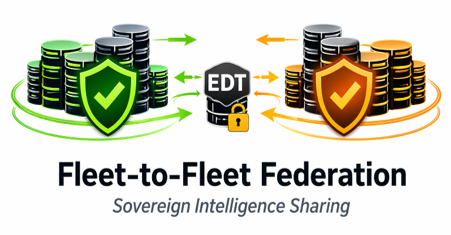
Fleets in different legal entities, regions, or classification levels can exchange signed results through the Control Plane without exposing prompts, weights, or private memory. Federation flows through audit, not around it.
Different from hub-and-spoke aggregation: each side keeps its own sovereign boundary. Each side keeps its own EDT. Bidirectional sharing where both sides can prove what crossed the line and why.
How federation works →
If you are a CIO, CISO, or Chief AI Officer at an organization of the profile above, we would rather spend a 45-minute architecture review session with your team than send you a product demo. The deliverable from the session: a tailored architectural sketch of how Operon would compose with your current platform mix, with specific evaluation criteria for how to make the buy/build decision.
45-minute session with our architecture team. The deliverable is a tailored architectural sketch of how Operon would compose with your current platform mix, plus a buy/build evaluation rubric.
Tell us your organization and your current platform mix. The session is 45 minutes with our architects and the output is a tailored architectural sketch.
Architecture reviews are run by our principal architects, not sales engineers. Sessions cover deployment posture, integration mapping, and a buy/build rubric specific to your platform mix.